
Health & Safety Policy for Flat Clearance Docklands
Purpose: This policy sets out the health, safety and environmental standards for our flat clearance operations in residential and commercial properties. The aim is to protect staff, clients and third parties during every stage of a flat clearance, rubbish removal or removal service. It applies to all employees, sub-contractors and any personnel working on site for flat clearances Docklands or associated clearance tasks.Scope and commitment
The company is committed to achieving high standards in safety management for flat clearance service Docklands and related waste handling. We will comply with statutory obligations, maintain safe systems of work, and ensure hazards are controlled. All activities, from initial site assessment to final disposal of waste, must be managed to reduce risk to the lowest reasonably practicable level. Responsibilities: Everyone involved in Docklands flat clearance operations has defined responsibilities. Managers must ensure safe resourcing and oversight; supervisors must enforce procedures; operatives must follow instructions and report hazards. Key duties include:
- Carrying out pre-clearance risk assessments for each flat clearance or rubbish collection job.
- Ensuring appropriate personal protective equipment (PPE) is worn for tasks such as manual handling, bulky item removal, and sorting recyclable and non-recyclable waste.
- Managing access, egress and traffic routes to prevent collisions and slips.
Risk assessment and control measures
Risk assessments are required before work begins. These must identify hazards such as unstable furniture, sharps, biological contamination, hazardous household chemicals, and potential asbestos-containing materials. Controls include safe handling techniques, segregation of hazardous waste, and use of mechanical aids where practical. All assessments should be recorded and reviewed for recurring risks in flat clearances and rubbish removal jobs. PPE and equipment: The company will provide and maintain suitable PPE including gloves, eye protection, appropriate footwear and high-visibility clothing. Equipment such as trolleys, lifting straps, and dust suppression tools must be inspected before use. Employees must report defective equipment immediately. Mandatory PPE use is enforced during heavy lifting, sorting and vehicle loading operations.
Training and competence: Staff will receive induction and ongoing training relevant to flat clearance Docklands operations. Training topics include manual handling, safe vehicle loading, identification of hazardous materials, and incident reporting. Competence will be assessed regularly and recorded to ensure a consistent standard of safe practice across all rubbish removal and clearance activities.
Manual handling procedures are a core element of safety for any flat clearance service. Operatives must plan lifts, use team lifts or mechanical aids for heavy items, and adopt correct lifting posture. Risk of musculoskeletal injury is reduced through job rotation and controlled lifting techniques. Careful routing of bulky items through corridors and stairwells helps prevent property damage and injury.
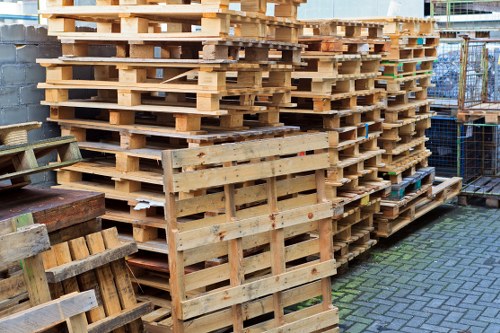 Hazardous materials and waste segregation: Special care is required when handling chemicals, batteries, fluorescent tubes, and potential asbestos. These items must be segregated for specialist disposal and not mixed with general rubbish. The team will follow established procedures for containment, labeling and temporary storage before transfer to approved waste handlers. Where necessary, trained specialists will be engaged for suspected hazardous materials encountered during a flat clearance.
Incident reporting, emergency response and first aid
All incidents, near misses and injuries must be reported without delay. A clear emergency response plan is maintained covering first aid provision, fire response and escalation to emergency services if needed. First aid equipment is accessible in vehicles and at base locations. Supervisors will ensure prompt medical attention where required and complete incident records for investigation and prevention of recurrence.Monitoring, review and continuous improvement
Safety performance is monitored through regular site inspections, toolbox talks and audits of clearance operations. Records of risk assessments, training, equipment checks and incident reports are maintained for review. The policy is subject to periodic review and revision to reflect operational changes, new risks, or legislative updates. Staff input is encouraged to drive practical improvements in our flat clearance and rubbish services.Environmental considerations: The company promotes responsible disposal and recycling as part of every flat clearance. Recyclable materials are separated where possible and hazardous wastes managed in accordance with industry practice. Minimising landfill through careful sorting and reuse reduces environmental impact and supports sustainable waste management in clearance operations.
Implementation and enforcement: Management will actively support this policy by allocating resources, ensuring clear lines of responsibility, and enforcing compliance. Employees are expected to cooperate fully, use provided controls and report concerns. Non-compliance with health and safety procedures may lead to corrective action. This policy forms an integral part of operational standards for flat clearance and rubbish removal activities and will be communicated to all team members.
Policy endorsement and review cycle: This Health & Safety policy is endorsed by senior management and will be reviewed at least annually or sooner if operational changes occur. Regular communication ensures that everyone involved in flat clearances Docklands understands their role in maintaining a safe working environment. Through consistent application of these principles, the company aims to protect people, property and the environment during every clearance operation.